

How is aluminum honeycomb made?
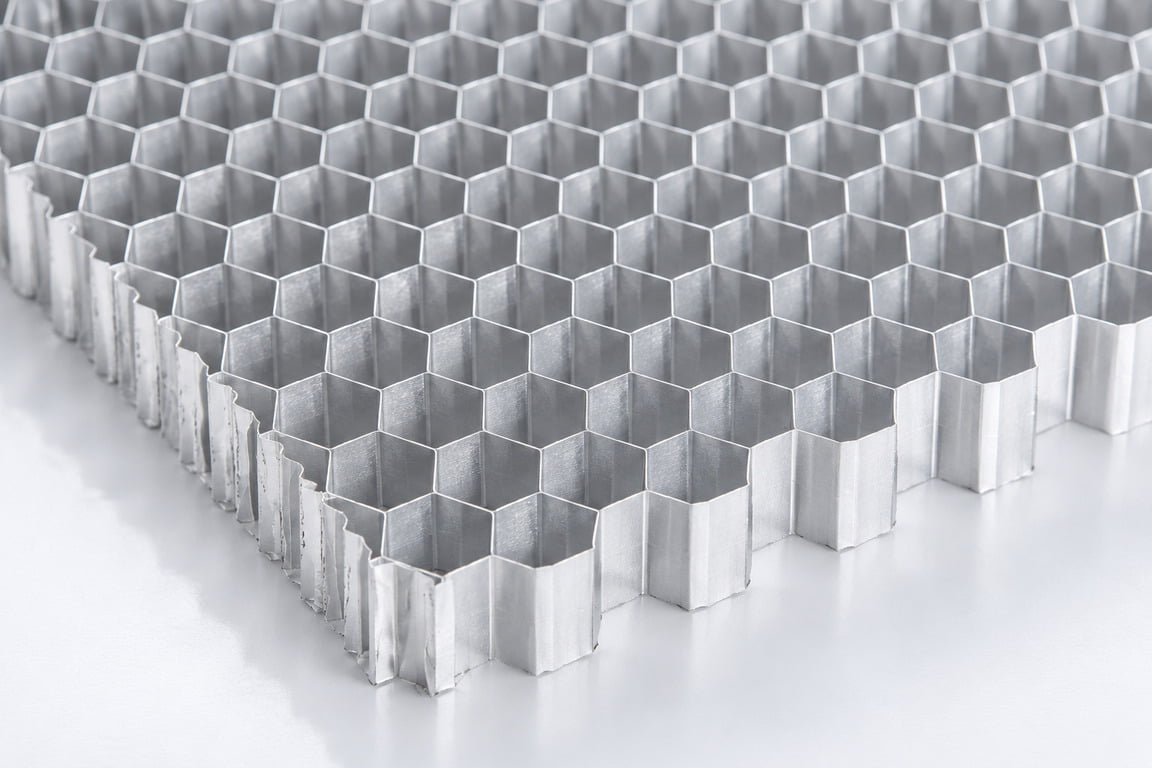
Aluminum honeycomb is widely used for lightweight structures requiring rigidity and dimensional stability. The final quality of an aluminum honeycomb core is determined by a combination of material specifications and manufacturing quality. Understanding the process helps customers evaluate whether the core specification and production method suit the intended application.
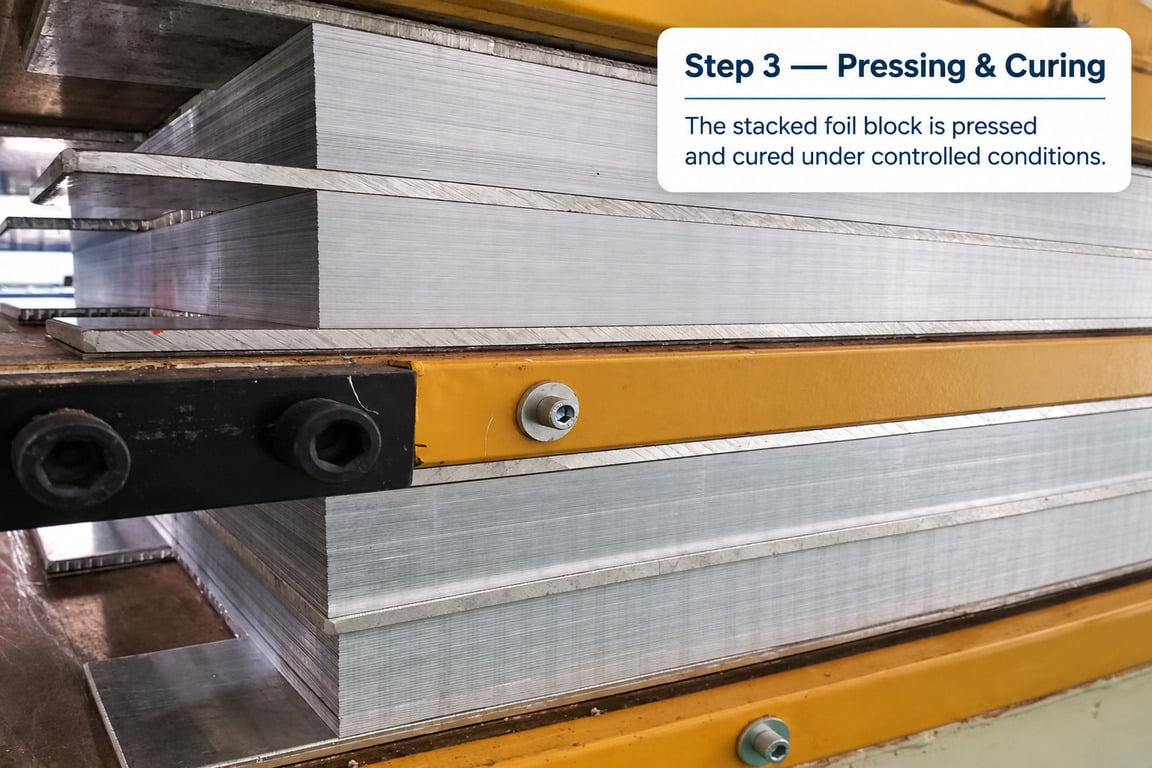
Most aluminum honeycomb is made using the adhesive-bonded method. Adhesive lines are applied to aluminum foil, the foil sheets are stacked into a block, pressed and cured, cut into slices of the required thickness, and then expanded to form the hexagonal cell structure.
Each stage affects geometry, dimensional accuracy, bond quality, and consistency, so the full process must be properly controlled.
What determines the base quality of an aluminum honeycomb core?
The aluminum foil should be selected according to the application, environmental exposure, mechanical requirements, and cost target.
A manufacturer should understand where the honeycomb will be used and then recommend or customize the appropriate alloy, foil thickness, cell size, density, and other specifications.
The base quality of an aluminum honeycomb core depends on the foil, its surface condition, and any required corrosion protection.
Common alloys such as 3003 are widely used for general industrial and architectural applications, while 5052 may be selected when higher strength or better corrosion resistance is required.
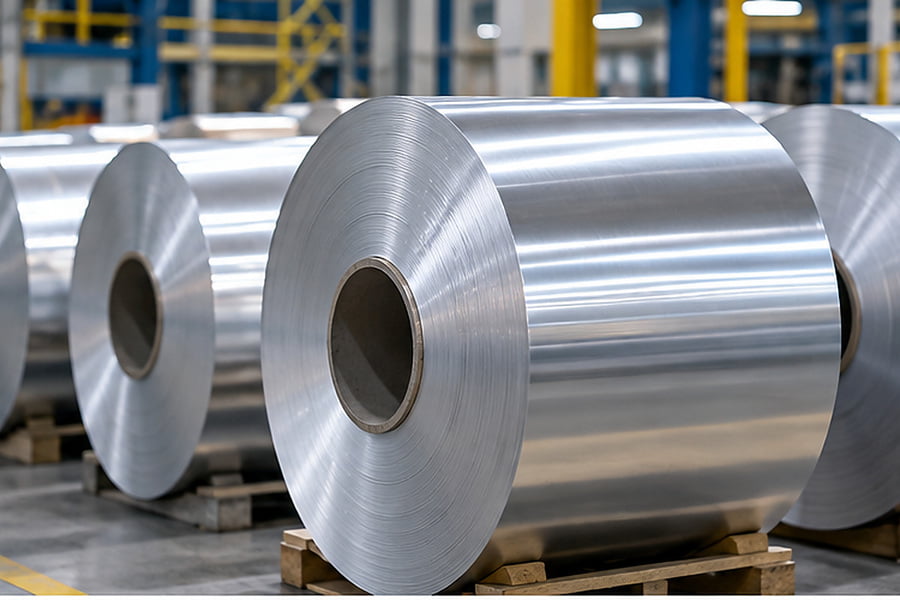
Raw material specifications should follow actual operating conditions. Customers should provide application, environment, mechanical requirements, and project-specific standards so the manufacturer can recommend a suitable configuration.
Choosing the Right Aluminum Foil Grade
Aluminum alloy affects strength, corrosion resistance, formability, and cost. Two commonly used grades are 3003 and 5052.
| Alloy Grade | Key Properties | Common Applications |
|---|---|---|
| 3003 | Good formability, suitable strength, good general corrosion resistance | Architectural panels, cleanrooms, lighting, general industrial applications |
| 5052 | Higher strength and better corrosion resistance | Transportation, marine-related applications, humid environments, higher-performance industrial structures |
Neither alloy is better for every project. For dry indoor environments, 3003 is often sufficient and more economical. For applications exposed to humidity, salt, or more demanding mechanical conditions, 5052 may be more suitable.
The choice should follow project requirements. Material certificates can be supplied when required.
The Importance of Surface Treatment
Additional surface treatment is not required for every aluminum honeycomb order.
When corrosion protection is required, additional treatment can be applied. At Mex-core, phosphoric-acid treatment is commonly used, while chromate conversion treatment can also be supplied according to customer specifications or application requirements.
Additional treatment should be selected according to the application rather than applied automatically.
Why is the gluing process so critical for aluminum honeycomb strength?
The hexagonal structure forms only after the foil layers have been bonded at precisely positioned lines. These bonded areas become the node bonds1 between adjacent foil layers.
Their consistency affects expansion and the finished core's shear and structural properties. Gluing therefore requires good control of adhesive position, amount, spacing, and continuity.
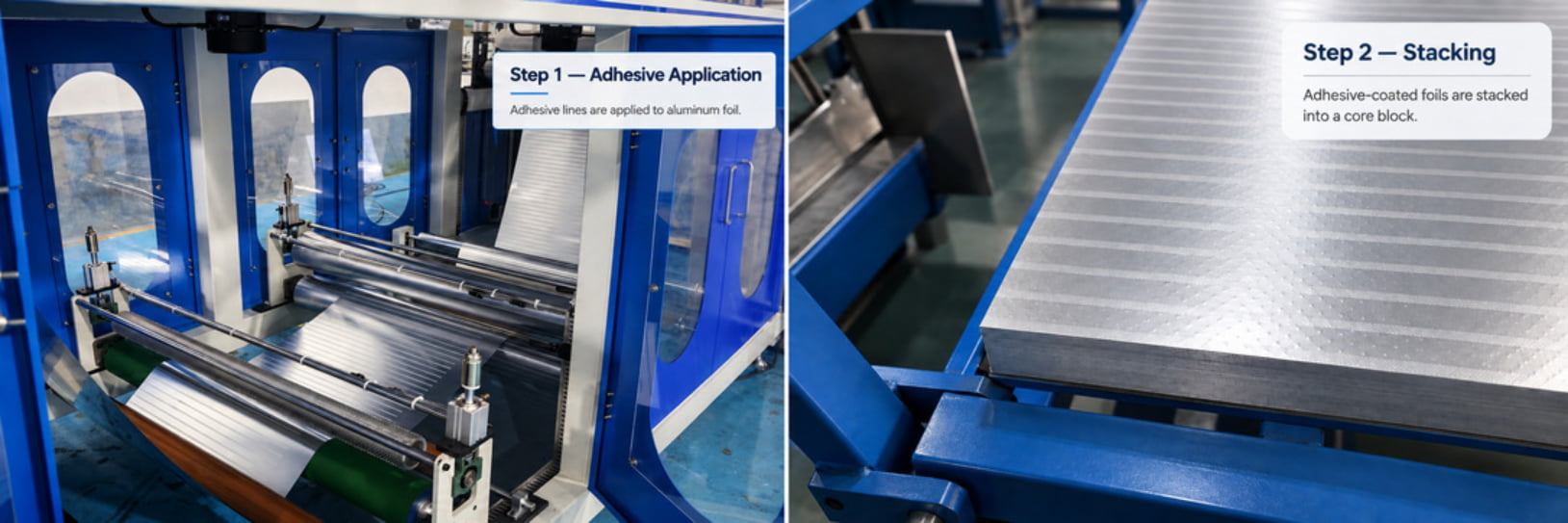
Weak, missing, or irregular adhesive lines can cause node-bond separation, uneven expansion, distorted cells, or reduced shear performance.
This differs from panel delamination. Node-bond failure occurs within the honeycomb core, where adjacent foil layers are bonded together. Panel delamination or face-to-core disbonding occurs later in sandwich-panel manufacturing, at the interface between the core and face sheets.2
The Science of the Node Bond
Adhesive lines form the node connections that later become the double-wall regions of the expanded honeycomb. During expansion, bonded nodes remain connected while unbonded foil sections open into cells.
- Consistent node bonds help distribute loads more uniformly.
- Weak or irregular bonds can create local weak areas or cause uneven expansion.
The adhesive used for aluminum honeycomb production is a specialized honeycomb core adhesive for foil-to-foil node bonding.
Its formulation, coating amount, curing temperature, pressure, and curing time must work together as one controlled process. The goal is to apply the correct amount in the correct position and cure it consistently.
Automated vs. Manual Application: A Critical Difference
Both manual and automated processes can produce usable honeycomb when properly controlled. Automation, however, can improve repeatability, stability, and efficiency, especially in continuous or higher-volume production.
Advantages of Automated Gluing & Stacking:
- More Consistent Adhesive Application: Better control of adhesive position and quantity.
- Improved Stacking Repeatability: Less variation between foil layers and more uniform cell geometry.
- Reduced Operator-Dependent Variation: Less influence from technique, fatigue, and alignment.
- Higher Production Efficiency: Higher throughput with more stable process parameters.
The key is not whether production is manual or automated, but whether gluing, stacking, curing, and final quality are properly controlled.
How does process control affect the final aluminum honeycomb specifications?
A technical drawing may specify cell size, density, core thickness, dimensions, and tolerances. Meeting these requirements consistently depends on control across multiple manufacturing stages.
Gluing, stacking, pressing, curing, cutting, and expansion all affect final cell geometry, dimensions, bond quality, and mechanical consistency.
A reliable process should repeatedly achieve the required specification within defined tolerances.
From Stacking and Pressing to a Solid Block
After adhesive lines are applied, the foil sheets are stacked in a controlled offset pattern.
-
Stacking:
The relationship between adhesive lines on adjacent sheets determines how the cells open during expansion. Accurate stacking supports consistent geometry and density; misalignment can cause irregular cells or dimensional variation. -
Pressing & Curing:
The stacked foil pack is placed into a hot press where controlled pressure, temperature, and curing time are applied.- Pressure: Ensures consistent contact between bonded foil layers.
- Heat & Time: Allow the honeycomb adhesive to cure according to the required conditions.
The appropriate parameters depend on the adhesive system, foil thickness, block dimensions, and production configuration and should remain within an established process window.
Automation and programmable control can reduce variation and improve batch-to-batch repeatability. The goal is stable production consistency within the specified tolerances.
As a manufacturer of both honeycomb core and production equipment, Mex-core uses this experience to control the relationship between equipment settings, process parameters, and final core specifications.
What are the final steps in making an aluminum honeycomb sheet?
After curing, the honeycomb block must still be converted into the required core thickness and supply form.
The final stages include precision slicing, optional expansion, dimensional control, and inspection. Even a well-bonded block can produce an unsatisfactory core if it is poorly cut or incorrectly expanded.
The solid aluminum honeycomb block is cut into unexpanded slices of the required thickness. These may be supplied unexpanded or expanded into the final hexagonal structure.
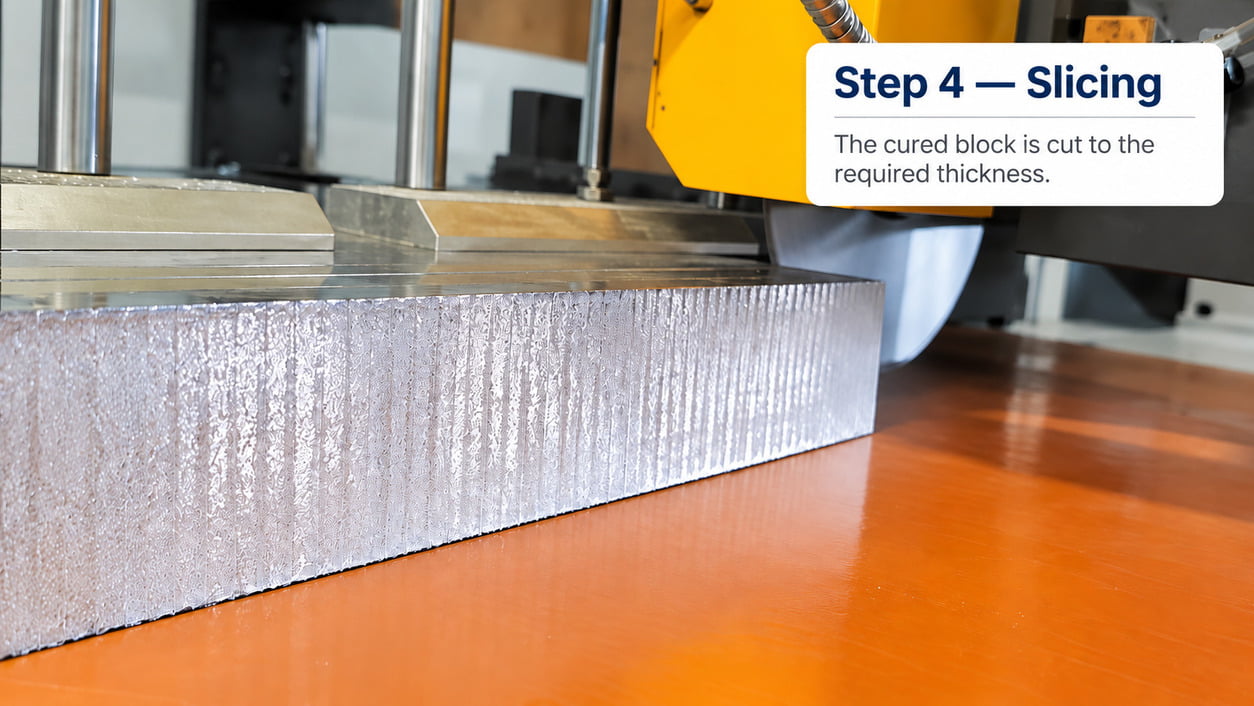
The final processing stages strongly affect surface flatness, thickness accuracy, cell geometry, and suitability for panel manufacturing.
Precision Cutting and Forms of Supply
Saw cutting is one of the most critical stages in aluminum honeycomb production.
The cured block must be cut accurately to the required core thickness. Poor sawing can cause:
- Uneven core thickness
- Poor surface flatness
- Difficulty during subsequent panel bonding
Key cutting factors include:
- Blade sharpness
- Machine stability
- Cutting accuracy
A flatter, more accurate cut surface improves contact during panel lamination. Thickness tolerance is therefore an important quality indicator.
A common industry cutting tolerance is approximately ±0.2 mm. For suitable specifications, Mex-core can achieve approximately ±0.1 mm.
After cutting, the core can be supplied in several forms:
| Supply Form | Description | Pros for Buyer | Cons for Buyer |
|---|---|---|---|
| Unexpanded Slice | Compact slice before expansion | Lower shipping volume and less handling damage | Requires expansion capability at the customer's facility |
| Expanded Sheet | Expanded by the manufacturer | Ready for panel manufacturing or processing | Higher shipping volume and greater handling risk |
| Expanded & Cut-to-Size | Expanded and cut to final dimensions | Reduces customer-side cutting, waste, and processing | Requires additional processing before shipment |
The Expansion Process
When expanded sheets are required, the unexpanded slice is opened using suitable expansion equipment or fixtures.
During expansion, bonded nodes remain connected while unbonded foil sections open to form the cells.
Expansion must be controlled according to the intended cell geometry and final dimensions. Incorrect expansion can affect cell shape, expanded dimensions, and dimensional consistency.
The required method may vary according to cell size, foil thickness, core thickness, and sheet dimensions.
Final Inspection and Quality Control
After cutting or expansion, the honeycomb core should be inspected before packing and shipment.
Depending on the specification, inspection may include:
- Alloy and material verification
- Core thickness
- Cutting tolerance
- Cell size and geometry
- Expanded dimensions
- Surface flatness
- Visual inspection of cell walls and node bonds
For expanded honeycomb, cell geometry and dimensional stability should be checked across the sheet. For unexpanded slices, thickness accuracy and cutting quality are especially important because they affect later expansion and panel production.
Final inspection confirms that the core meets the specification before shipment.
Frequently Asked Questions
What is the difference between bonded and welded aluminum honeycomb?
The aluminum honeycomb described in this article uses adhesive-bonded foil layers that are later expanded into a hexagonal structure.
Welded aluminum honeycomb3 uses welded node connections instead of adhesive bonding.
The two structures are manufactured differently and suit different requirements. Bonded honeycomb is widely used in architectural, transportation, cleanroom, lighting, panel manufacturing, and general industrial applications.
Welded honeycomb may be considered when operating temperature, bonding method, or other special requirements make a welded structure more suitable.
What are the most common aluminum foil grades used?
Two commonly used alloys are 3003 and 5052.
3003 is widely used for general industrial, architectural, cleanroom, and lighting applications where a practical balance of performance and cost is required.
5052 may be selected when higher strength or better corrosion resistance is required, particularly in humid, marine-related, transportation, or other demanding environments.
The alloy should be selected according to actual operating conditions.
How does cell size affect aluminum honeycomb performance?
Cell size is one of several parameters that influence density and mechanical performance.
When alloy, foil thickness, core height, and other parameters are comparable, a smaller cell size generally means more cell walls within a given area. This can increase density and improve certain compressive and shear properties.4
Cell size should not be evaluated independently. Final performance also depends on:
- Aluminum alloy
- Foil thickness
- Core density
- Core thickness
- Cell geometry
The cell size should therefore be selected together with the other core parameters.
Can you get aluminum honeycomb in different shapes?
Yes.
Expanded aluminum honeycomb can be cut into different sizes and shapes according to the final component design. Cut-to-size processing can reduce waste and simplify subsequent manufacturing.
Certain configurations can also be formed for curved applications, but achievable geometry depends on cell size, foil thickness, core thickness, forming direction, and required curvature.
Complex forming requirements should be evaluated for the specific project.
Conclusion
Understanding how aluminum honeycomb is made means understanding how each manufacturing stage affects the final core.
The process includes:
- Aluminum foil selection
- Gluing
- Foil stacking
- Pressing
- Sawing
- Expansion when required
- Final inspection and quality control
No single step determines quality by itself.
Stable production depends on controlling the complete process and matching the material specification to the actual application.
Customers should provide the operating environment, dimensions, mechanical requirements, supply form, and other project conditions so the manufacturer can recommend a suitable specification.
If you are sourcing aluminum honeycomb core or considering setting up honeycomb production, Mex-core has experience in both honeycomb core manufacturing and honeycomb production equipment.
Our team can help review alloy, cell size, foil thickness, core height, dimensions, supply form, and production requirements according to your application.
"ASTM C363/C363M-16(2024) - Honeycomb Core Node ...", https://standards.iteh.ai/catalog/standards/astm/5d308aac-6921-4061-8476-183d9a4312a6/astm-c363-c363m-16-2024?srsltid=AU7gw4Wd6oyg0W-R5VEa6kXyvIycwSoeW3yQZyzkFNO7YleF2lBrqQQW. A source could provide a formal definition of a 'node bond' as the adhesive joint connecting adjacent foil sheets in an unexpanded honeycomb block, which forms the double-walled section of the cell after expansion. Evidence role: definition; source type: paper. Supports: The term 'node bond' refers to the adhesive joint between foil sheets in a honeycomb core.. ↩
"Face Sheet/Core Disbond Growth in Honeycomb ...", https://ntrs.nasa.gov/citations/20160005994. A source could define panel delamination (or face/core debonding) as a critical failure mode in sandwich structures, distinguishing it from cohesive failure within the core material itself, and explain its impact on structural integrity. Evidence role: definition; source type: paper. Supports: Panel delamination is a failure mode in sandwich structures.. ↩
"Friction stir seam- and spot-welded aluminium ...", https://www.sciencedirect.com/science/article/abs/pii/S0924013624001675. A source could describe the manufacturing process for welded honeycombs, such as resistance welding or laser welding, and explain that this method is often chosen for applications requiring performance at temperatures exceeding the limits of adhesives. Evidence role: general_support; source type: research. Supports: Welded honeycomb is manufactured using different processes and is used in high-temperature applications.. ↩
"Gibson-Ashby Model - an overview", https://www.sciencedirect.com/topics/engineering/gibson-ashby-model. A source on the mechanics of cellular solids could provide the theoretical basis and empirical evidence showing how decreasing cell size, while keeping other parameters constant, increases the relative density and, consequently, the elastic modulus, compressive strength, and shear strength of a honeycomb structure. Evidence role: mechanism; source type: paper. Supports: There is a direct relationship between honeycomb cell size, relative density, and mechanical properties.. ↩