

What are honeycomb cores used for?
Honeycomb cores are lightweight cellular materials used in a wide range of structural, composite, airflow-control, light-control, and industrial applications.
The right honeycomb core is selected according to the requirements of the application, including structural performance, weight, environment, fire performance, and cost.
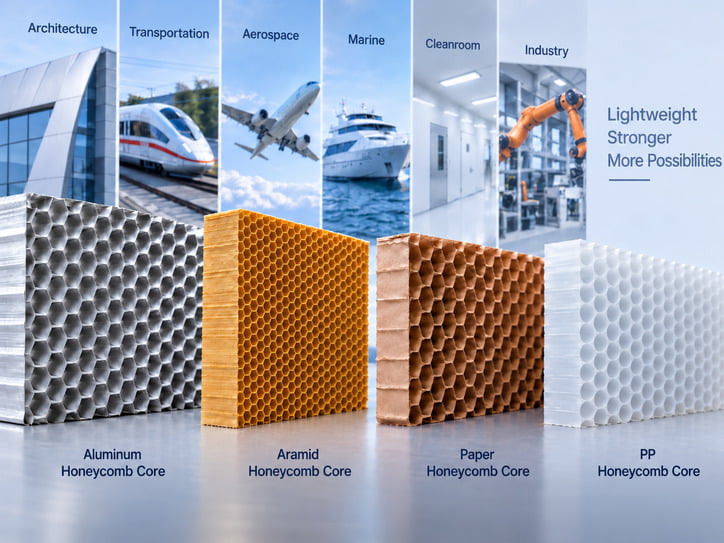
Aluminum honeycomb cores are widely used in architectural, transportation, cleanroom, lighting, marine, and industrial applications. Aramid honeycomb cores are commonly selected for aerospace, UAVs, and other high-performance lightweight composite structures. Paper and polypropylene (PP) honeycomb cores are used where lower cost, lightweight filling, or moisture resistance is more important.
What Does a Honeycomb Core Do?
The cellular structure of a honeycomb core provides high stiffness with relatively little material. Depending on the material and design, honeycomb cores can be used to:
- Reduce structural weight
- Increase stiffness and dimensional stability
- Carry compressive and shear loads
- Support skins in lightweight sandwich structures
- Absorb energy in certain applications
- Control airflow or light in specialized components
The required function varies from one application to another, so the material and specification should be selected according to the final operating conditions.
What Are Aluminum Honeycomb Cores Used For?
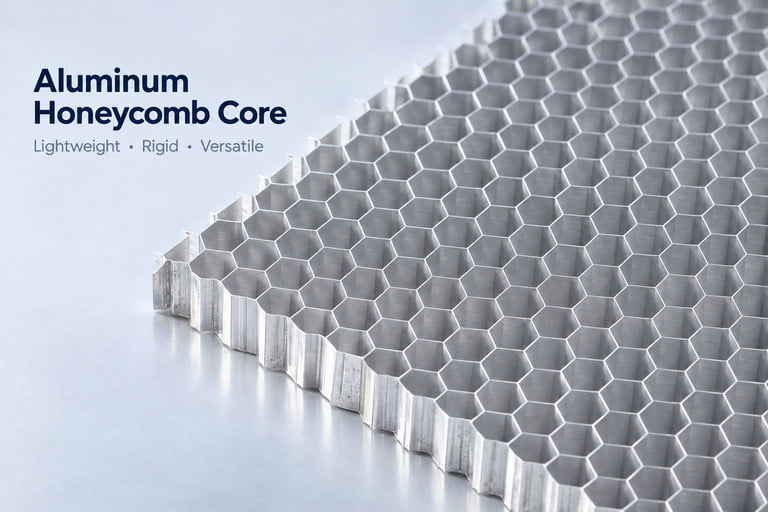
Aluminum honeycomb core is one of the most widely used honeycomb materials because it combines low weight, good rigidity, corrosion resistance, and a wide range of customizable specifications.
Architectural and Building Applications
Aluminum honeycomb core is widely used in architectural and interior structures where low weight, rigidity, flatness, and dimensional stability are important. Typical applications include facade and interior decorative structures, ceiling and partition systems, and lightweight elevator or door structures. The required alloy, cell size, foil thickness, or density depends on the structural design, loading conditions, surface materials, and performance requirements of the final application. A decorative interior structure, for example, may have very different requirements from a load-bearing floor or transportation structure.
Transportation and Railway Applications
Weight reduction is particularly important in railway, automotive, marine, and other transportation structures. Aluminum honeycomb core is commonly used in floors and load-bearing structures, doors and partitions, and other lightweight interior structures where low weight must be combined with durability and structural performance. For these applications, the appropriate material and specification should be selected according to load conditions, vibration, environmental exposure, service life, and applicable project or safety requirements. Higher mechanical performance may require a different combination of alloy, cell size, foil thickness, or density rather than simply selecting one fixed specification.
Cleanroom and Controlled-Environment Applications
Aluminum honeycomb core can be used as a lightweight structural core in cleanroom wall, ceiling, and partition systems. In a separate application, regular honeycomb cells can also be used in airflow-straightening and ventilation components. The parallel cell structure helps guide airflow and reduce lateral turbulence. These two uses should be distinguished: one uses the structural properties of the honeycomb core, while the other uses the cell geometry to influence airflow.
Lighting and Glare Control
Aluminum honeycomb is also used in lighting louvers and optical-control components. The honeycomb cells restrict off-axis light, reduce glare, and help control the beam angle. Cell size and core depth influence the final cut-off angle and light-control performance. This application is common in professional lighting systems where precise control of unwanted light is required.
| Application | Typical Alloy | Typical Cell Size | Primary Function |
|---|---|---|---|
| Architectural Facade | 3003 | Project-dependent | Lightweight, Flatness, Dimensional Stability |
| Railway & Transportation | 3003 / 5052 | Project-dependent | Lightweight, Structural Performance, Durability |
| Cleanroom & Airflow Components | 3003 / 5052 | Project-dependent | Structural Support or Airflow Control |
| Lighting Louvers | 3003 | Project-dependent | Light Direction, Glare Reduction |
Industrial and Marine Applications
Aluminum honeycomb core is also used in machinery, enclosures, marine structures, ventilation components, filtration-related structures, and other industrial applications where lightweight construction and dimensional stability are required.
Selecting Aluminum Honeycomb Core
The application should determine the required specification. Important parameters may include:
- Aluminum alloy
- Cell size
- Foil thickness or density
- Expanded dimensions
These parameters should be considered together according to the actual structure and application requirements.
Explore our Aluminum Honeycomb Core →
When Is Aramid Honeycomb Core Used?
Aramid honeycomb core is selected when very low weight, high specific stiffness, fatigue resistance, and compatibility with advanced composite structures are important.1
It is widely used in aerospace and other weight-sensitive applications, although the final material selection depends on structural requirements, environmental conditions, and applicable specifications.
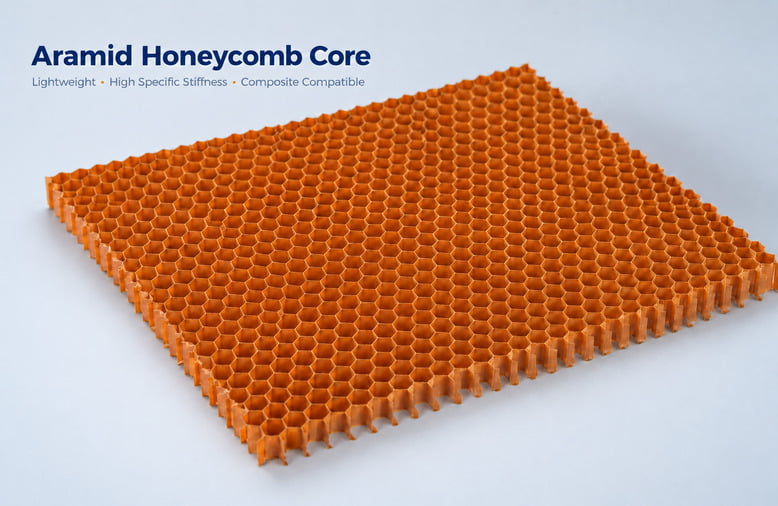
Aramid honeycomb is typically manufactured from aramid fiber paper impregnated with resin.2 Its cellular structure provides high structural efficiency at a relatively low weight.
Aerospace Applications
Aerospace is one of the most established application areas for aramid honeycomb core. Reducing structural weight can improve fuel efficiency, increase payload capacity, and improve overall vehicle performance. Typical applications include aircraft interior structures such as floors, partitions and bulkheads; control surfaces and fairings; and helicopter, satellite, and other lightweight aerospace structures. The required grade and specification depend on the mechanical, environmental, fire-performance, and qualification requirements of the project.
UAVs and Lightweight Composite Structures
UAVs and drones are particularly sensitive to structural weight. Aramid honeycomb can be used as the core of lightweight composite sandwich structures for airframes and wings, fairings and covers, and other components where low mass and rigidity are important. The final selection depends on the required stiffness, strength, density, and service environment.
Motorsport, Marine, and High-Performance Industrial Applications
Aramid honeycomb is also used in selected motorsport, marine, transportation, and industrial composite structures. These applications generally justify the higher material cost when weight reduction, fatigue performance, or structural efficiency provides a significant engineering benefit.
Selecting Aramid Honeycomb Core
Buyers should consider:
- Density
- Cell size
- Core thickness
- Mechanical performance
- Applicable project specifications
For aerospace or other highly regulated applications, material qualification, test requirements, and customer-specific specifications should be confirmed before material selection. Explore our Aramid Honeycomb Core →
Where Are Paper and PP Honeycomb Cores Used?
Not every application requires the structural performance of aluminum or aramid honeycomb.
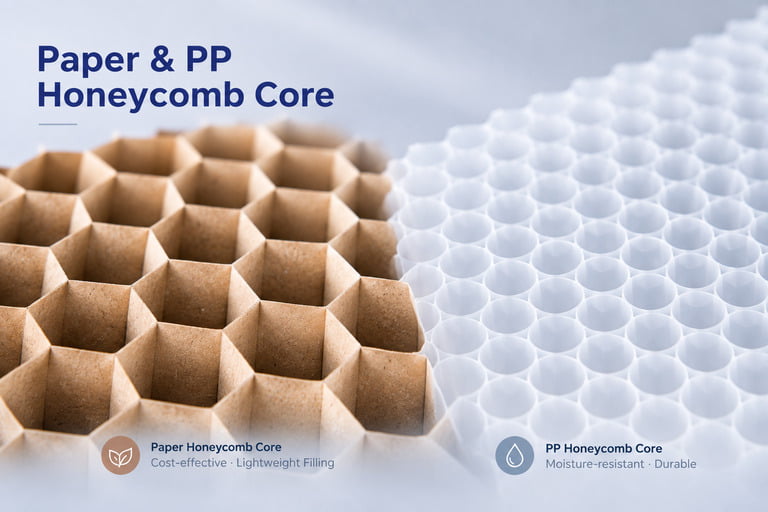
Paper and polypropylene honeycomb provide practical alternatives where cost, lightweight filling, or resistance to moisture is more important.
Paper Honeycomb Core
Paper honeycomb is a lightweight and cost-effective core material commonly used in dry indoor applications. Typical uses include interior doors and furniture structures, lightweight interior panels, and packaging or void-filling applications. Moisture can significantly reduce the strength and dimensional stability of paper honeycomb3, so it is generally preferred for dry environments.
PP Honeycomb Core
Polypropylene honeycomb has very low water absorption and good resistance to moisture and many chemicals. Typical applications include marine and vehicle structures, outdoor or industrial structures, and applications exposed to humid or wet environments. PP honeycomb generally provides lower stiffness than aluminum or aramid honeycomb, but its moisture resistance and durability make it useful where environmental exposure is more important than maximum structural performance.
How Do You Choose the Right Honeycomb Core?
Selecting a honeycomb core should start with the application rather than with a specific material or specification. Before selecting the core, consider:
- What loads must the structure carry?
- How important is weight reduction?
- Will the core be exposed to moisture, chemicals, heat, or corrosion?
- Are there fire, smoke, or other industry requirements?
- What manufacturing and bonding process will be used?
- What mechanical performance is required?
- What cost level is appropriate for the project?
Once these requirements are clear, the appropriate honeycomb core material and technical specification can be selected.
Frequently Asked Questions
How Is Honeycomb Core Strength Measured?
Two important mechanical properties are compressive strength and shear strength. Compressive strength describes the core's resistance to loads applied perpendicular to the cell structure. Shear strength describes its ability to resist forces acting parallel to the core surface. The required values depend on the application, and mechanical performance should not be judged from a single parameter alone.
Can Honeycomb Cores Be Bent or Curved?
Some honeycomb structures can be formed around curved surfaces. Standard honeycomb is relatively rigid, while formable or over-expanded configurations can provide greater flexibility in specific directions. The achievable curvature depends on the material, cell geometry, core thickness, and forming process.
Why Is Cell Size Important in a Honeycomb Core?
Cell size influences core density, surface support, mechanical performance, weight, and cost. When the material and wall construction are comparable, reducing cell size generally increases core density and can improve compressive and shear performance4. However, cell size should never be evaluated alone. Material, foil or wall thickness, density, core height, and cell geometry all influence the final properties of the honeycomb core.
Conclusion
Honeycomb cores are used wherever engineers need to reduce weight while maintaining structural efficiency or introducing specialized functions such as airflow or light control.
Aluminum and aramid honeycomb serve many of the more demanding structural and lightweight applications, while paper and PP provide practical solutions where cost or environmental resistance is the primary consideration.
The application should always come first. Once the structural, environmental, weight, and cost requirements are clear, the appropriate honeycomb core material and specification can be selected.
If you are evaluating aluminum or aramid honeycomb core for a project, Mex-core can help review the required cell size, density, core height, dimensions, and supply form.
"High-cycle and very-high-cycle fatigue properties of CFRP-aramid honeycomb sandwich structure in three-point bending", International Journal of Fatigue, 2022. https://www.sciencedirect.com/science/article/abs/pii/S0142112321004266 ↩
"Aramid Honeycomb Cores under Constant Pressure: Unveiling the Out-of-Plane Compression Deformation", Materials, 2024. https://pmc.ncbi.nlm.nih.gov/articles/PMC11280948/ ↩
Wang, D.-M., Wang, J., and Liao, Q.-H., "Investigation of mechanical property for paper honeycomb sandwich composite under different temperature and relative humidity", Journal of Reinforced Plastics and Composites, 2013. https://journals.sagepub.com/doi/10.1177/0731684413475912 ↩
Prakash, M. D. Antony Arul, et al., "Influence of Cell Size on the Core Shear Properties of FRP Honeycomb Sandwich Panels", Materials and Manufacturing Processes, 2012. https://www.tandfonline.com/doi/full/10.1080/10426914.2011.560227 ↩