What is the lifespan of aluminum honeycomb?
Getting a clear answer about component longevity can be difficult. When it comes to the lifespan of aluminum honeycomb, there is no single number that applies to every project. Choosing the wrong specification can lead to premature failure, delays, and unnecessary cost. The key is to understand that service life depends on how well the material and panel design match the application.
Aluminum honeycomb does not have a fixed lifespan. Its durability depends on alloy, core specification, surface treatment, environmental exposure, and mechanical loading. It is also important to distinguish the aluminum honeycomb core from a finished honeycomb sandwich panel. In a finished panel, adhesive bonding, skins, edge sealing, and fabrication quality can strongly affect service life. In a stable, dry indoor environment, a properly specified aluminum honeycomb structure can provide a very long service life. In harsh conditions, durability depends on controlling corrosion, moisture ingress, thermal cycling, and fatigue.
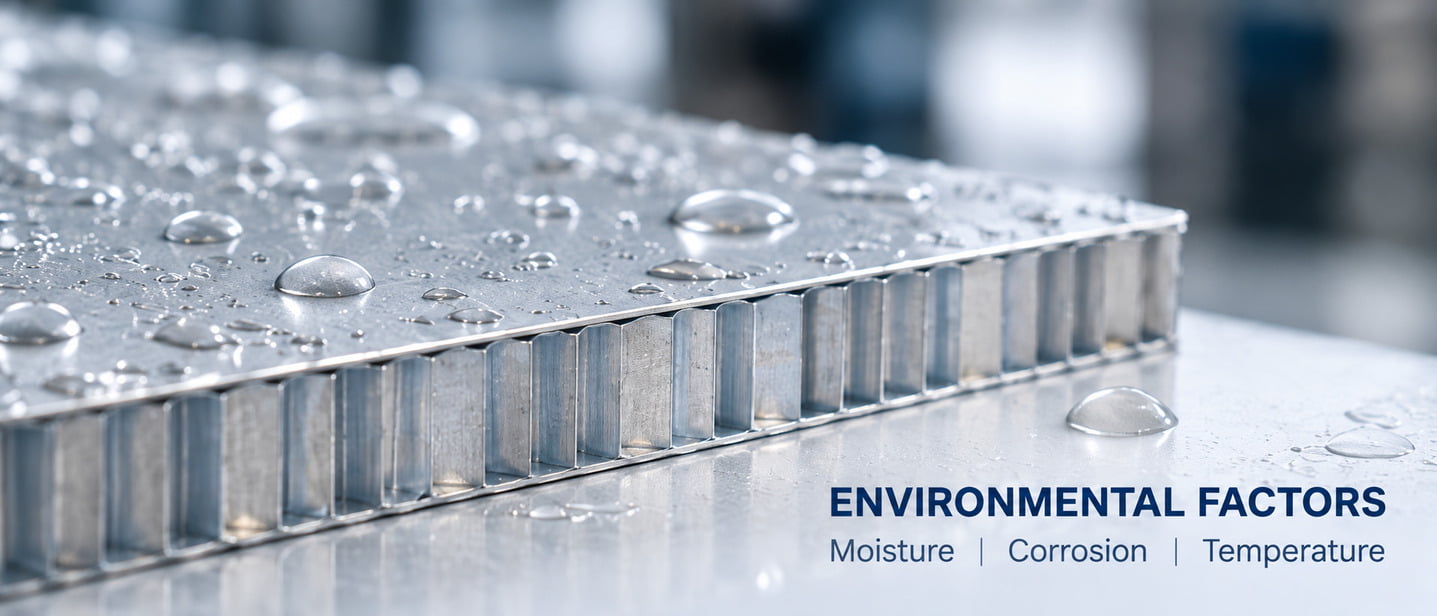
Now that we know service life is designed rather than fixed, the next question is which variables matter most. The following factors help determine whether an aluminum honeycomb component can meet its required service life.
How do environmental factors impact the lifespan of aluminum honeycomb?
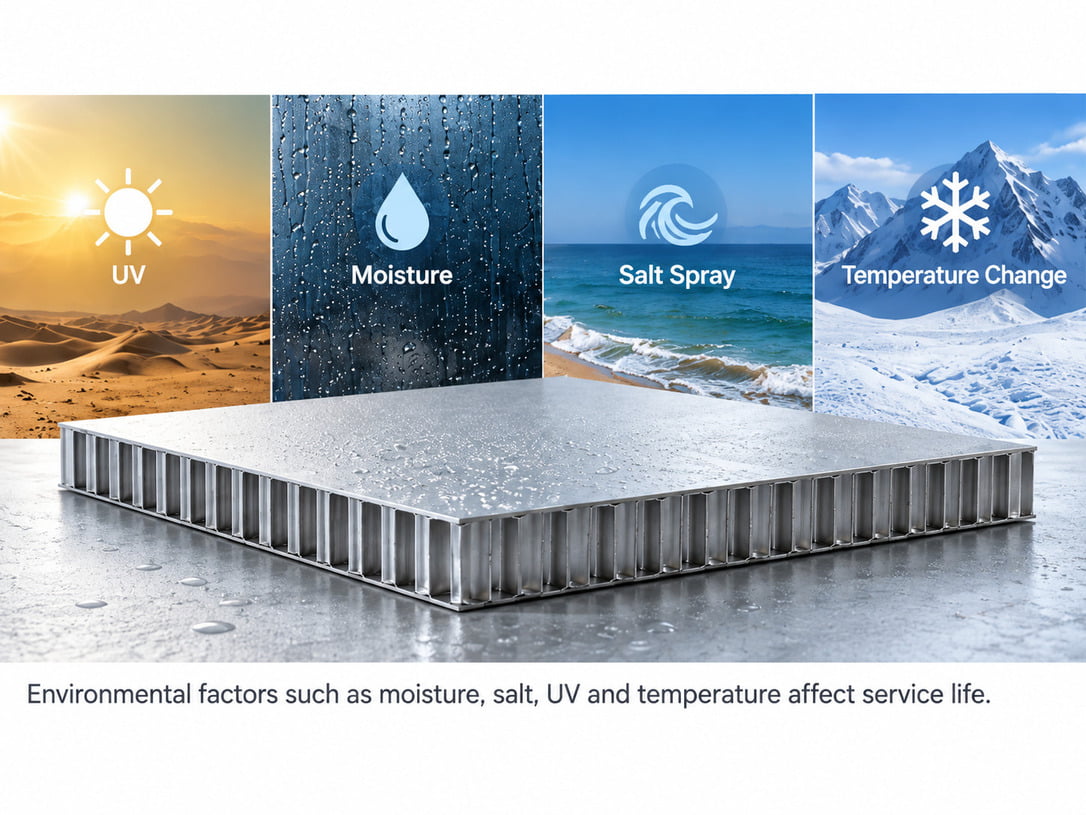
A lightweight aluminum honeycomb structure may perform very differently in a dry indoor environment than in a humid, coastal, outdoor, or chemically exposed location.
The main environmental risks are moisture and corrosive agents. The lifespan of aluminum honeycomb depends not only on the alloy but, in a finished panel, also on how well the structure is protected and sealed. Choosing the right alloy, such as 5052 for applications requiring higher corrosion resistance, and using effective edge sealing can reduce the risk of premature deterioration.
Dive Deeper
When customers ask about longevity, my first question is about the operating environment. From our experience at Mex-core, many durability problems can be reduced through appropriate alloy selection, surface treatment, sealing, and panel design.
Moisture and Corrosion: The Primary Enemy
Aluminum naturally forms a protective oxide layer, but this protection has limits.1 For a finished honeycomb panel, one major risk is water ingress through poorly sealed edges, fastener holes, joints, or damaged skins.
Once inside, water can cause several problems:
- Galvanic Corrosion: If dissimilar metals are in contact in the presence of an electrolyte such as saltwater, corrosion can accelerate.
- Adhesive Degradation: Long-term moisture exposure can weaken the bond between the core and skins, depending on the adhesive system and exposure conditions.
- Freeze-Thaw Damage: If moisture accumulates inside the cells and freezes repeatedly, it may reduce the long-term durability of the sandwich structure.
Choosing the Right Alloy for a Longer Lifespan
The alloy is the first line of defense. 3003 and 5052 are both widely used for aluminum honeycomb core production.
| Feature | 3003 Aluminum Alloy | 5052 Aluminum Alloy |
|---|---|---|
| Primary Alloying Element | Manganese (Mn) | Magnesium (Mg) |
| Corrosion Resistance | Good for general conditions | Very good, including humid and marine environments |
| Strength | Moderate | Generally higher than 3003 |
| Typical Applications | Interiors, cleanrooms, general industry | Transportation, marine-related, aerospace, high-humidity areas |
5052 generally offers higher strength and better corrosion resistance, while 3003 is often sufficient and more cost-effective for dry, controlled indoor use.2 This does not mean 5052 automatically provides a fixed number of extra service years. The alloy should be matched to the environmental and mechanical requirements.
The Role of Surface Treatments
Surface treatment can improve durability and prepare aluminum for later bonding or coating processes.
At Mex-core, phosphoric-acid treatment is commonly used for aluminum honeycomb foil, while chromate conversion treatment can also be supplied when required by the customer's specification or application.
Phosphoric-acid-based preparation has a long history in structural aluminum bonding. Chromate conversion coatings are also widely used to improve corrosion protection and prepare aluminum surfaces for subsequent processes.3
The treatment should be selected according to alloy, bonding process, environmental exposure, and customer requirements. No single treatment is best for every application.
Can mechanical stress shorten the lifespan of aluminum honeycomb?
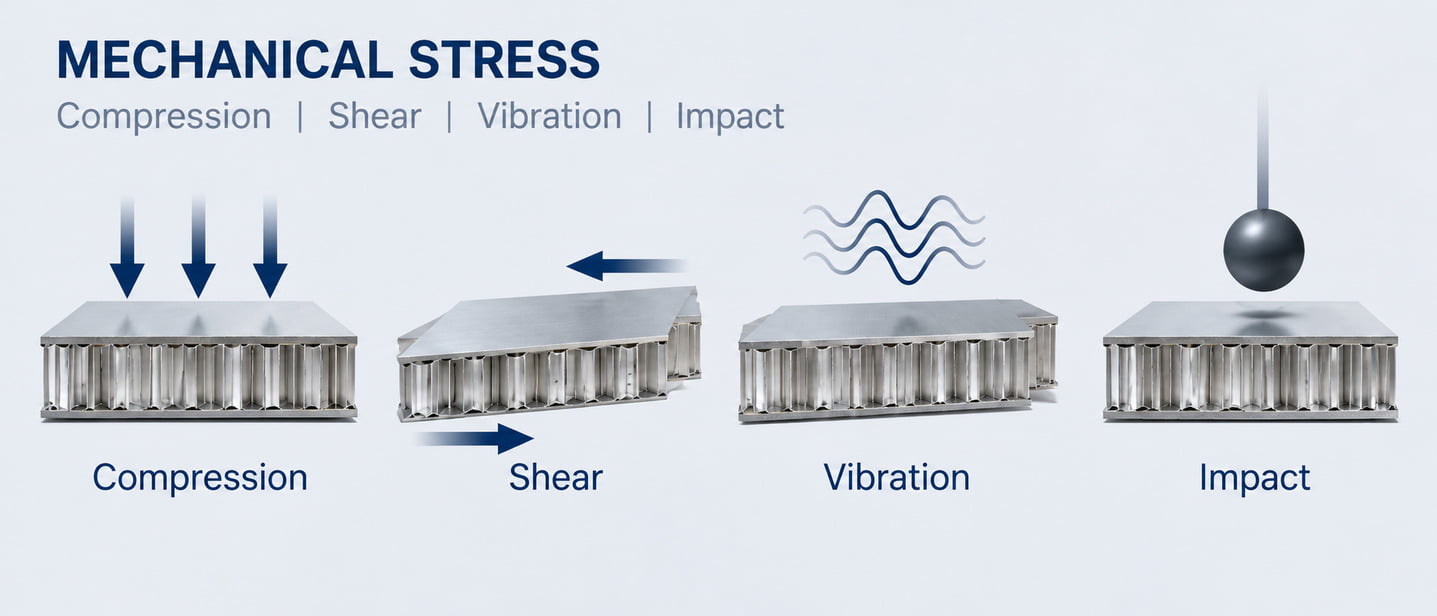
Your application may involve train vibration, aircraft impact, or a heavy static load on a floor. In these cases, the honeycomb structure must be specified to resist fatigue, deformation, crushing, and delamination.
Yes, mechanical stress can shorten service life. The lifespan of aluminum honeycomb under load depends on the correct combination of core density, cell size, foil thickness, core height, skins, and bonding system. Failure may occur through local core crushing, core shear failure, skin deformation, adhesive failure, or face-to-core delamination rather than fracture of the aluminum foil itself.
Dive Deeper
Honeycomb offers an excellent strength-to-weight ratio, but the structure still needs to match the actual mechanical demands. An underspecified core or panel construction can reduce service life.
Fatigue from Vibration
This is especially important in railway interiors, automotive components, RVs, and aerospace structures. Repeated vibration and cyclic loading can cause fatigue damage in the core, face-to-core interface, adhesive bondline, or several areas at once.4
Mitigation:
- Select an Appropriate Core Density: Thicker foil or a different cell size can increase density, strength, and stiffness, but higher density alone does not guarantee longer fatigue life.
- Use a Suitable Adhesive: The bonding system should match the expected vibration, temperature, moisture exposure, and manufacturing process.
- Proper Engineering Analysis: Finite Element Analysis (FEA) can help identify stress concentrations and evaluate structural response.5 Demanding or safety-critical applications should also be physically tested.
In my work with railway interior manufacturers, fatigue resistance is an important consideration. The specification process therefore considers both core properties and the complete panel construction.
Long-Term Static Load
In flooring, industrial platforms, or shelving, panels may carry a constant load for long periods. Creep is the tendency of a material to deform under sustained stress6, but long-term panel deformation should not automatically be attributed to the aluminum core alone.
Deflection can result from face-sheet bending, core shear deformation, local compression, adhesive behavior, support conditions, temperature, and load duration.
Mitigation: The complete sandwich structure should be evaluated. Core compression and shear strength, skin stresses, panel deflection, local bearing loads, supports, and bonding performance all matter. Higher core density can improve some mechanical properties, but it is only one part of the design.
Impact Resistance
Honeycomb structures absorb energy efficiently, but sharp or high-energy impacts can cause skin denting, core crushing, puncture, or face-to-core disbonding.7 Impact performance depends on both the core and the face sheets.
Mitigation:
- Smaller Cell Size: Smaller cells can provide more support beneath the skin and may improve resistance to local indentation.
- Thicker Foil: Thicker foil generally improves compression and shear properties, but impact resistance should still be evaluated as part of the complete panel.
Why is panel fabrication so critical to honeycomb lifespan?
You may specify the correct alloy and density, yet the finished panel can still fail earlier than expected.
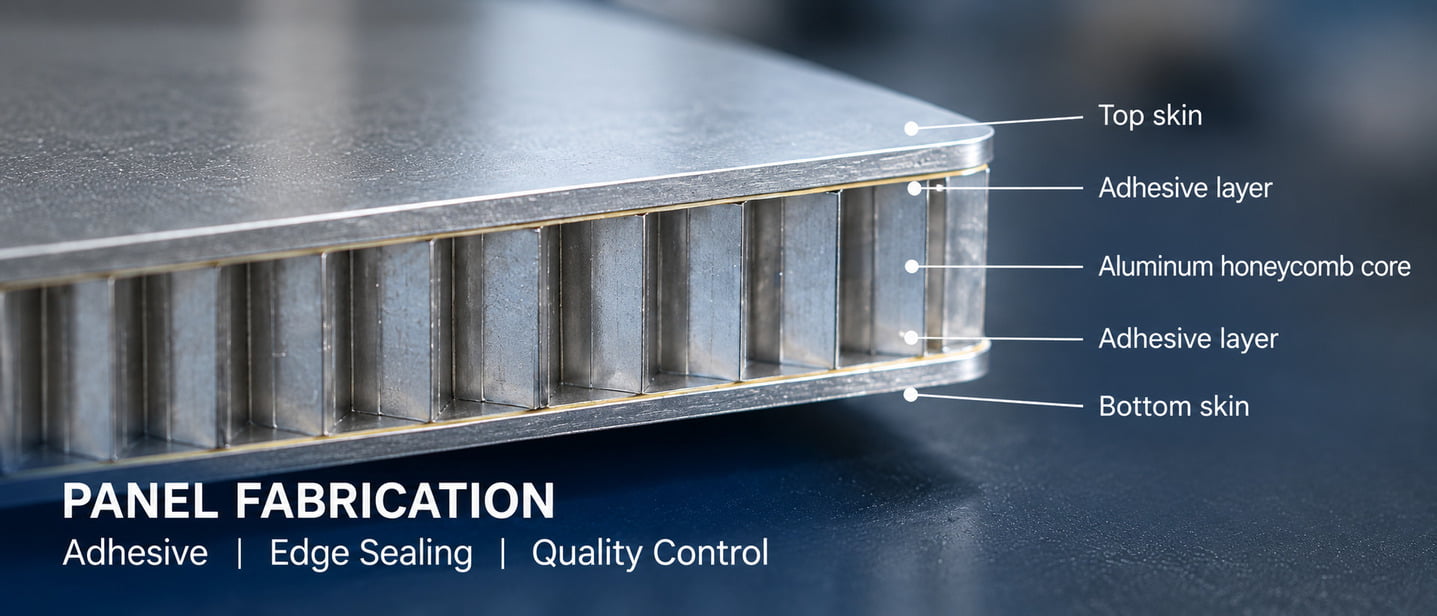
The reason is that the lifespan of an aluminum honeycomb panel depends strongly on fabrication quality. Adhesive selection, surface preparation, bonding quality, and edge sealing can all affect long-term durability.
Dive Deeper
A honeycomb core is only one part of a sandwich system. How the panel is assembled is therefore a major factor in long-term performance.
The Adhesive Bond: The Critical Interface
The adhesive transfers load between the skins and the core. If the bond fails, the panel can lose a substantial amount of stiffness and load-carrying capability.
- Environmental Compatibility: The adhesive must tolerate the expected temperature, humidity, water, and chemical exposure.
- Surface Preparation: Core and skin surfaces must be clean and properly prepared. Oil, dust, moisture, or inconsistent treatment can weaken the bond.
- Curing Process: Temperature, pressure, and curing time must be properly controlled to achieve consistent bond performance.
From our experience, a reported "core failure" may actually come from the adhesive interface, skin preparation, sealing system, or panel fabrication. The complete panel should therefore be evaluated, not just the core.
The Importance of Effective Edge Sealing
Moisture is one of the main environmental risks for honeycomb panels, and the edges are common entry points. Effective edge sealing is important in humid, wet, or corrosive environments.
Common sealing methods include:
- Edge Banding: Applying a solid strip or profile around the perimeter.
- Potting: Filling edge cells with epoxy, polyurethane, or another suitable compound.
- Caulking/Sealants: Applying a compatible flexible sealant where movement must be accommodated.
No sealing system should automatically be assumed permanent. The method should match the panel design, exposure, and maintenance requirements.
Thermal Expansion Mismatches
Different materials expand and contract at different rates. This is measured by the Coefficient of Thermal Expansion (CTE)8. If skins, edge members, or other bonded materials have very different thermal expansion behavior from the aluminum core, temperature changes can create stress at the adhesive interface. Repeated cycling may contribute to bond fatigue or interfacial damage.
A panel designer should therefore consider material compatibility and adhesive properties when significant temperature changes are expected.
Frequently Asked Questions
Does a 5052 alloy aluminum honeycomb last longer than a 3003 alloy?
Not necessarily in every application. In corrosive, humid, coastal, or marine environments, 5052 generally offers better corrosion resistance and may provide a durability advantage. In dry, controlled indoor applications, 3003 is often sufficient and more economical. Actual service life also depends on surface treatment, mechanical requirements, bonding, sealing, and the operating environment.
Can aluminum honeycomb be repaired?
For a finished aluminum honeycomb panel with significant internal damage, we generally recommend replacing the complete panel rather than attempting a repair.
Core crushing, internal corrosion, major delamination, water ingress, or extensive impact damage can be difficult to assess from the outside. Even if the visible damage looks limited, the surrounding core and adhesive interfaces may also be affected.
Specialized repair procedures do exist in certain industries, particularly aerospace, but they require qualified engineering evaluation, controlled materials, processes, and inspection.
From our experience at Mex-core, repairing damaged honeycomb core is not a common solution for general industrial aluminum honeycomb panels. If structural integrity has been compromised, replacing the complete panel is usually the more practical and reliable option.
How does temperature affect the lifespan of aluminum honeycomb?
The aluminum core itself performs well across a relatively wide temperature range. In a finished panel, however, the usable range may be limited by the adhesive, skins, coatings, sealants, or edge materials. Repeated thermal cycling can also create stress because different materials expand at different rates.
For high-temperature, low-temperature, or repeated thermal-cycle applications, the complete sandwich system should be evaluated rather than the aluminum core alone.
Is a denser honeycomb core more durable?
In terms of certain mechanical properties, a denser aluminum honeycomb core generally provides higher compressive and shear strength and stiffness. Density can be increased with thicker foil, smaller cells, or a different honeycomb configuration.
However, higher density does not automatically mean longer overall service life. It may improve compression, shear, and resistance to some local damage, but it does not solve corrosion, moisture ingress, adhesive degradation, poor sealing, or incorrect panel design. Core density should be selected according to the actual mechanical and environmental requirements.
Conclusion
Ultimately, the lifespan of aluminum honeycomb is not a fixed number in a datasheet. It is the result of material selection, engineering design, fabrication, and operating conditions.
The key factors fall into three areas: material specification—including alloy, cell size, foil thickness, density, and surface treatment; panel fabrication—including adhesive selection, bonding, and edge sealing; and application conditions—including moisture, corrosion, temperature, vibration, static loading, and impact.
By shifting the question from "How long will aluminum honeycomb last?" to "What specification and panel design are required to achieve the target service life?", engineers and procurement teams can make better material and design decisions.
To achieve the required service life, the aluminum honeycomb core should match the actual operating environment and mechanical requirements. Contact our engineering team at Mex-core to discuss your application, and we can help determine a suitable aluminum honeycomb specification for further engineering evaluation.
"Passivation (chemistry)", https://en.wikipedia.org/wiki/Passivation_(chemistry). Aluminum's corrosion resistance derives from a naturally forming passive oxide film; however, this film is susceptible to breakdown in the presence of chloride ions, extreme pH conditions, and galvanic contact with dissimilar metals, as documented in standard references on aluminum corrosion behavior. Evidence role: mechanism; source type: encyclopedia. Supports: Aluminum forms a thin, adherent aluminum oxide (Al₂O₃) layer upon exposure to air that provides passive corrosion protection, but this layer can be compromised by chlorides, acidic or alkaline environments, and galvanic coupling.. Scope note: General corrosion references may not address the specific geometry or confined-cell environment of honeycomb structures. ↩
"What's The Difference Between 3003 Aluminum & 5052?", https://www.kloecknermetals.com/blog/whats-the-difference-between-5052-3003-aluminum/. Published alloy property data from standards bodies such as ASM International or the Aluminum Association confirm that 5052-H series tempers achieve higher minimum tensile strengths and demonstrate better resistance to saltwater corrosion than 3003 alloys of equivalent temper. Evidence role: general_support; source type: institution. Supports: Aluminum alloy 5052 (Al-Mg) exhibits higher tensile and yield strength and superior corrosion resistance compared to 3003 (Al-Mn), particularly in marine and humid environments.. Scope note: Property comparisons depend on temper designation; direct comparison requires specifying equivalent temper conditions. ↩
"Efficacy of MIL-DTL-5541 Compliant Non-Chromate ...", https://www.osti.gov/servlets/purl/1890384. Chromate conversion coatings on aluminum are governed by specifications such as MIL-DTL-5541, which defines requirements for chemical film coatings that provide corrosion resistance and a receptive surface for organic coatings or adhesives. Evidence role: general_support; source type: government. Supports: Chromate conversion coatings applied to aluminum provide corrosion resistance and improve adhesion for subsequent painting or bonding, and are specified under standards such as MIL-DTL-5541.. Scope note: Regulatory restrictions on hexavalent chromium (e.g., under REACH in the EU) are not addressed in the article and may affect applicability in certain markets. ↩
"Fatigue of composite honeycomb sandwich panels under ...", https://www.sciencedirect.com/science/article/abs/pii/S0263822322001052. Research on fatigue behavior of honeycomb sandwich structures reports that damage initiation under cyclic loading can occur in the core cell walls, at the adhesive fillet between core and face sheet, or within the face sheet itself, with failure mode depending on load amplitude, frequency, and panel geometry. Evidence role: mechanism; source type: research. Supports: Cyclic mechanical loading of aluminum honeycomb sandwich panels can initiate and propagate fatigue damage in the core foil, at the core-to-face-sheet adhesive interface, and within the adhesive bondline itself.. Scope note: Published fatigue data are typically specific to particular core densities, adhesive systems, and loading configurations, limiting direct generalization. ↩
"Modelling and analysis of honeycomb sandwich structure ...", https://www.sciencedirect.com/science/article/abs/pii/S2214785319325568. Published research on structural analysis of honeycomb sandwich panels demonstrates that finite element methods, including homogenized and detailed cell-level models, can predict stress concentrations, core shear failure, and face-sheet delamination under static and cyclic loading conditions. Evidence role: general_support; source type: research. Supports: Finite element analysis methods have been applied to model stress distributions, failure modes, and fatigue behavior in aluminum honeycomb sandwich structures.. Scope note: FEA accuracy for honeycomb structures depends heavily on the modeling approach chosen (equivalent continuum vs. explicit cell geometry) and requires experimental validation. ↩
"Review: developments in the creep of materials over a period ...", https://pmc.ncbi.nlm.nih.gov/articles/PMC12513960/. Creep is defined in materials science as the slow, time-dependent plastic deformation of a solid under constant stress, with deformation rate influenced by stress magnitude, temperature, and material microstructure. Evidence role: definition; source type: encyclopedia. Supports: Creep is the time-dependent, permanent deformation of a material subjected to a constant stress below its yield strength, typically more pronounced at elevated temperatures.. Scope note: Aluminum alloys generally exhibit low creep rates at ambient temperatures; the article's context of room-temperature structural panels may represent a conservative concern for most applications. ↩
"Dynamic responses and energy absorption of sandwich ...", https://www.sciencedirect.com/science/article/abs/pii/S0734743X21003018. Experimental and analytical studies on aluminum honeycomb sandwich panels under impact loading document energy absorption through progressive core crushing, with damage modes including face-sheet perforation, core shear failure, and adhesive disbonding depending on impactor geometry and energy level. Evidence role: mechanism; source type: research. Supports: Aluminum honeycomb cores absorb impact energy through progressive cell wall buckling and crushing, but localized high-energy or sharp impacts can produce skin indentation, core densification, and face-to-core disbonding.. Scope note: Impact performance is highly dependent on face-sheet material and thickness, adhesive system, and boundary conditions, so results from specific test configurations may not generalize directly. ↩
"Thermally Induced Failure of Bonded Composite-Metal Joints", https://www.osti.gov/servlets/purl/2001965. The coefficient of thermal expansion (CTE) is a material property expressing the fractional dimensional change per unit temperature; for aluminum alloys, published values are approximately 23 × 10⁻⁶ K⁻¹, which may differ significantly from carbon fiber, steel, or polymer face-sheet materials used in composite sandwich panels. Evidence role: definition; source type: encyclopedia. Supports: The coefficient of thermal expansion quantifies the fractional change in a material's dimensions per degree of temperature change; aluminum alloys have a CTE of approximately 23 × 10⁻⁶ /°C.. Scope note: CTE values vary modestly among aluminum alloy series; the article does not specify which skin or edge materials are being compared. ↩