What is the difference between Nomex and Kevlar?
Choosing between high-performance aramid materials can be challenging because both offer low weight, high performance, and strong resistance to demanding environments. Understanding the core difference between Nomex and Kevlar helps engineers and procurement teams identify which material characteristics are most relevant to a specific application.
The primary difference between Nomex and Kevlar lies in their molecular structure. Nomex is a meta-aramid, while Kevlar is a para-aramid. Meta-aramid is particularly valued for thermal stability, flame resistance, and dielectric performance, while para-aramid generally provides higher tensile strength and modulus. In honeycomb applications, however, final core performance also depends on factors such as the paper or reinforcement form, resin system, density, cell size, core thickness, and specific core grade.
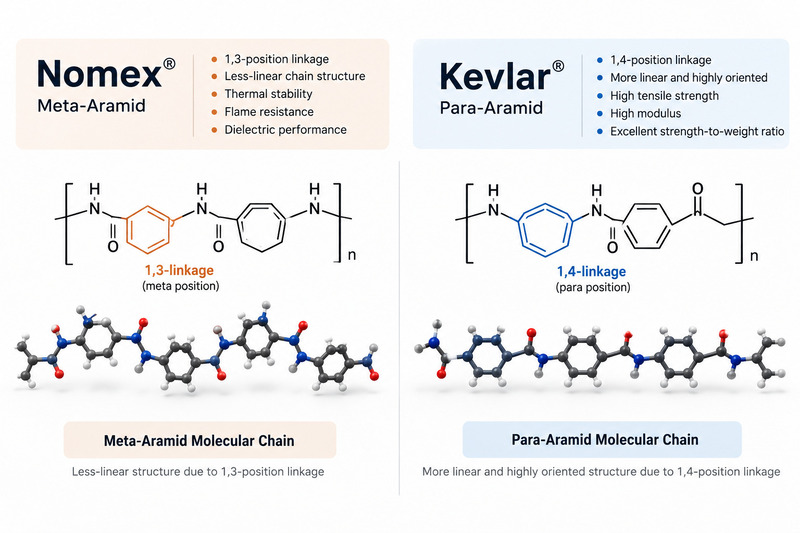
Nomex® and Kevlar® are DuPont trademarks. In industrial honeycomb selection, the broader technical distinction is between meta-aramid and para-aramid materials. The right choice is therefore not about which material is universally better, but which combination of properties best matches the project's structural, environmental, thermal, and regulatory requirements.
What is the chemical difference between Nomex and Kevlar really?
Relying on brand names alone can obscure the material science behind honeycomb performance. A useful comparison begins with the difference between meta-aramid and para-aramid structures, while recognizing that the finished honeycomb core is an engineered material whose performance cannot be predicted from the fiber family alone.
Nomex is the brand name for a meta-aramid fiber, while Kevlar is the brand name for a para-aramid fiber. Their different polymer-chain arrangements result in different balances of thermal, mechanical, and dielectric properties.

Nomex and Kevlar are DuPont aramid brands representing meta-aramid and para-aramid materials, respectively. Their molecular structures give them different property profiles, but honeycomb performance also depends on how the aramid material is converted into a core, including the resin system, density, cell geometry, and manufacturing process.
The Meta-Aramid Structure of Nomex: Inherent Thermal Stability
Nomex is a meta-aramid, meaning its molecular chains are linked at the 1 and 3 positions of the aromatic ring1. This less-linear molecular arrangement contributes to its thermal stability, flame resistance, and useful dielectric properties.
- Flame Resistance: Nomex is inherently flame resistant. When exposed to high heat or flame, it chars rather than melting or dripping.
- Thermal Performance: Meta-aramid maintains useful properties at elevated temperatures and is widely used where heat resistance is important. Actual service-temperature capability depends on the specific paper, resin system, honeycomb grade, and operating conditions, so degradation temperature should not be treated as the allowable continuous service temperature.
- Electrical Insulation: Meta-aramid paper provides good dielectric properties and is widely used in electrical insulation systems such as transformers, motors, and generators.
Meta-aramid honeycomb is also widely used as a structural core, including in aerospace, railway, marine, and other lightweight sandwich structures. For applications such as aircraft interiors2 or railway interiors3, fire and smoke performance may be an important design consideration, but the use of a meta-aramid core alone does not automatically demonstrate compliance of the final panel or component.
The Para-Aramid Structure of Kevlar: Extreme Tensile Strength
Kevlar is a para-aramid, meaning its molecular chains are linked at the 1 and 4 positions in a more linear and highly oriented structure4. Strong intermolecular bonding and molecular alignment contribute to its high tensile strength and modulus.
- Tensile Strength: At the fiber level and on an equal-weight basis, para-aramid is known for very high tensile strength. This makes it valuable in applications where tensile reinforcement and low weight are important.
- Strength-to-Weight Ratio: Para-aramid combines low density with high specific strength and stiffness, making it attractive for weight-sensitive structures.
- Toughness and Impact Resistance: Para-aramid fibers can absorb significant energy and are therefore widely used in impact-resistant and high-performance composite applications.
Para-aramid honeycomb may be selected for UAVs, high-performance transportation, motorsport, marine, or other lightweight structures when the required combination of stiffness, strength, weight, and impact performance justifies it. However, these applications are not exclusive to para-aramid; the actual core grade and design loads should determine the final material choice.
How do you choose between Nomex and Kevlar for your application?
Both materials can be used in high-performance lightweight structures, so the decision should not be based only on the material name. The more useful question is which performance requirements are most critical to the final component. The choice becomes clearer when you ask, "Which performance requirements and failure risks are most important in this application?" Selection should consider thermal exposure, structural loading, impact, moisture, dielectric requirements, weight targets, processing conditions, and applicable project standards.
A risk-based selection approach is useful, but meta-aramid and para-aramid should not be treated as mutually exclusive "thermal" and "structural" materials. Both can serve structural roles, and both offer useful thermal and dielectric characteristics. The final decision should be based on the data for the specific honeycomb grade.
A Risk-Based Selection Framework
Instead of treating Nomex and Kevlar as direct competitors, consider them different aramid families with different property balances. The correct choice depends on which performance characteristics are most important and whether the specific honeycomb grade meets the project's mechanical, environmental, processing, and regulatory requirements.
| Here is a simple table to guide your decision-making process: | Decision Factor | Choose Nomex (Meta-Aramid) When... | Choose Kevlar (Para-Aramid) When... |
|---|---|---|---|
| Primary Risk | Thermal exposure, flame performance, or environmental requirements are major design factors | Higher tensile performance, impact resistance, or weight-sensitive structural performance is a major design factor | |
| Key Property Needed | Thermal stability, flame resistance, dielectric performance, and balanced structural properties | Higher tensile strength and modulus, toughness, and high specific mechanical performance | |
| Example Application | Aircraft and railway interiors, structural sandwich panels, electrical or industrial applications | UAV structures, high-performance composites, radomes, motorsport, or other weight-sensitive structures | |
| Regulatory Focus | Applications where FST performance may be important; final compliance depends on the complete sandwich construction and required testing | Structural integrity and application-specific mechanical requirements; qualification depends on the complete component and applicable standards | |
| Electrical Needs | Meta-aramid provides useful dielectric properties; confirm the performance of the specific core grade | Para-aramid honeycomb can also provide good dielectric properties; confirm the performance of the specific core grade |
Real-World Application Scenarios
Let's put this framework into practice with two simplified examples.
-
Scenario 1: Railway Carriage Interior Panels. A manufacturer developing railway interior panels may place high priority on fire, smoke, and toxicity performance under requirements such as EN 45545-23. Meta-aramid honeycomb may be considered because of its thermal and flame-resistant characteristics, while still providing lightweight structural support. However, using a meta-aramid core does not by itself mean the finished panel complies with EN 45545-2; the complete panel construction must be evaluated and tested according to the applicable requirements.
-
Scenario 2: Structural Body of a Survey Drone. A UAV engineering team may need a lightweight and rigid airframe that can withstand flight loads and occasional impact. Para-aramid honeycomb may be selected when its specific mechanical properties provide an advantage for the required weight target. However, the selection should be based on the actual core density, cell size, thickness, shear properties, structural design, and loading conditions rather than assuming that all UAV structures require para-aramid. By defining the primary requirements first and then comparing the actual data of available core grades, material selection becomes a more defensible engineering decision.
Does manufacturing affect the performance of Nomex and Kevlar honeycomb?
Selecting the appropriate aramid family is only the first step. Even cores made from similar meta-aramid or para-aramid materials can show different performance if the resin system, cell geometry, density, node bonding, or manufacturing consistency differs.
Absolutely. The base aramid material is only one part of the final product. The honeycomb manufacturing process—including the resin system, node-bond adhesive, cell geometry, density control, and process consistency—has a significant impact on final core performance, regardless of whether the core uses meta-aramid or para-aramid reinforcement.
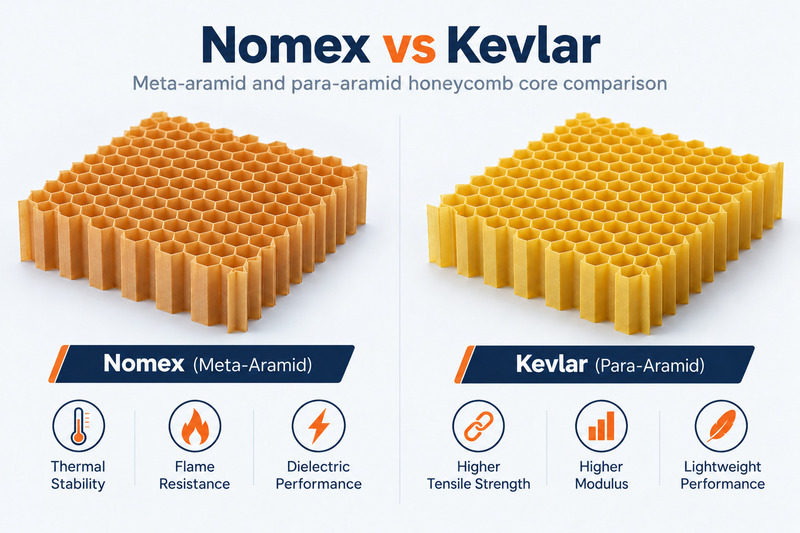
A buyer is not simply purchasing aramid paper or fiber. A honeycomb core is an engineered structure whose final properties depend on the interaction between the reinforcement, resin system, node bonds, density, cell geometry, and manufacturing process.
The Role of Resin Systems
Many commercial aramid honeycomb grades use phenolic resin systems, but phenolic resin is not universal. The resin system varies according to the honeycomb grade and intended application, and some para-aramid honeycomb products use modified epoxy or other resin systems.
- Resin Quality and Content: The resin system and resin content influence core stiffness, compressive and shear properties, environmental resistance, and weight. The objective is to achieve the required balance for the specific core grade rather than simply maximizing resin content.
- Curing Process: Resin impregnation and resin curing must be controlled according to the selected resin system. Temperature, time, coating or impregnation level, and other process parameters should follow the established process requirements for that core grade. When evaluating a supplier, it is useful to understand the resin system used, how resin impregnation is controlled, and how the curing process is monitored.
The Importance of Adhesion and Cell Geometry
Many aramid honeycomb cores are manufactured by applying adhesive lines to aramid paper, stacking the sheets, bonding the node areas, expanding the structure, and then carrying out subsequent resin impregnation and curing according to the product design.
- Node-Bond Adhesive: The adhesive used at the honeycomb nodes must provide stable and durable bonding. Weak, incomplete, or improperly cured node bonds can cause node-bond separation or local core failure under load and can reduce the consistency of the finished core.
- Cell Uniformity: At Mex-core, fully automatic stacking technology helps improve stacking repeatability and reduce variation between layers. More consistent stacking supports more regular cell geometry and stable batch-to-batch performance. Automation is one process-control tool; final quality still depends on the complete manufacturing and inspection system.
Material family alone does not determine honeycomb performance. Core grade, density, cell size, resin system, node-bond quality, dimensional consistency, and manufacturing control must all be considered when evaluating a supplier or comparing meta-aramid and para-aramid cores.
Frequently Asked Questions
Is Kevlar stronger than Nomex?
At the fiber level, para-aramid such as Kevlar generally provides higher tensile strength and modulus than meta-aramid such as Nomex. However, this does not mean that every para-aramid honeycomb core will outperform every meta-aramid core.
Honeycomb-core performance depends on the specific core grade, density, cell size, thickness, resin system, loading direction, and manufacturing quality. Meta-aramid honeycomb is itself widely used in demanding structural applications.
Are Nomex and Kevlar waterproof?
No. Aramid honeycomb should not be considered waterproof.
Aramid materials can absorb moisture, while resin treatment can improve moisture and environmental resistance. The actual moisture behavior depends on the aramid material, resin system, resin content, exposed cut surfaces, core construction, and service environment.
For applications exposed to significant humidity or water, the complete sandwich construction, sealing method, and environmental requirements should be evaluated rather than assuming the honeycomb core itself is waterproof.
What is the cost difference between Nomex and Kevlar?
Para-aramid honeycomb can be more expensive than standard meta-aramid honeycomb, but the actual price depends on the specific core grade and specification.
Important cost factors include cell size, density, core thickness, resin system, performance grade, dimensions, required testing, and order quantity. Price should therefore be compared using equivalent technical specifications rather than material family alone.
Can Nomex and Kevlar be used in the same composite panel?
Yes, specialized applications may use hybrid constructions that combine different aramid materials or different reinforcement types to achieve a particular balance of properties.
However, for honeycomb-core selection, it is more common to choose a specific meta-aramid or para-aramid core grade based on the primary structural, environmental, thermal, dielectric, and processing requirements of the project.
Conclusion
Navigating the choice between high-performance aramid materials requires looking beyond brand names. The fundamental difference between Nomex and Kevlar comes from their chemical identities as meta-aramid and para-aramid fibers.
At the fiber level, meta-aramid is generally valued for its thermal stability, flame resistance, and dielectric properties, while para-aramid generally provides higher tensile strength and modulus. However, these characteristics should not be used as a simple "thermal material versus structural material" rule. Both material families can be used in structural honeycomb applications, and final performance depends on the specific core grade.
The right choice for a project depends on the complete set of application requirements. Fire and smoke performance, structural loading, impact resistance, dielectric requirements, environmental exposure, density, cell size, core thickness, and manufacturing quality may all influence the final decision. Likewise, selecting a particular aramid family does not automatically demonstrate compliance with standards and regulations such as EN 45545-2 or 14 CFR 25.853; the final sandwich construction or component must meet the applicable testing and compliance requirements.
If you are evaluating aramid honeycomb for your next project, our engineering team can help compare meta-aramid and para-aramid core options according to your actual application requirements and identify a suitable core specification.
"Functional Aromatic Polyamides - PMC - NIH", https://pmc.ncbi.nlm.nih.gov/articles/PMC6419023/. This source explains the structural distinction between meta- and para-aramid polymers, including the 1,3- and 1,4-position linkages that influence molecular arrangement and resulting thermal and mechanical properties. ↩
"14 CFR 25.853 -- Compartment interiors.", https://www.ecfr.gov/current/title-14/chapter-I/subchapter-C/part-25/subpart-D/subject-group-ECFR1e1f52030ba4797/section-25.853. This regulation establishes flammability requirements for aircraft interior materials and components. Compliance depends on the finished material or construction meeting the applicable test requirements, rather than on the honeycomb core material alone. ↩
"BS EN 45545-2:2020+A1:2023 - Railway applications. Fire protection on railway vehicles. Requirements for fire behaviour of materials and components", https://landingpage.bsigroup.com/LandingPage/Undated?UPI=000000000030334174. This standard defines fire-behaviour requirements for materials and components used on railway vehicles. Compliance applies to the finished material or component under the relevant test requirements, not to an individual honeycomb core material in isolation. ↩
"Kevlar® Aramid Fiber Technical Guide", https://ptacts.uspto.gov/ptacts/public-informations/petitions/1558158/download-documents?artifactId=YTlZrZf1cAC1Z-3N0yDZiQXsDhAow09339b4juEi3akuz8feeYWi0g8. This technical guide describes the para-aramid molecular structure of Kevlar and explains how its highly oriented polymer chains contribute to high tensile strength and modulus at the fiber level. ↩